Monday 30th August 2010
Olympic Youth Development Centre Visit.
The students arrived at the impressive centre on Monday to meet with the team there and see how they can collaborate. The Olympic Youth Development Centre (OYDC) was opened in May 2010 and provides the best sports facilities in Zambia. The centre is the first of its kind in the world and will allow the national teams to develop their skills.
Bessy, the director at the OYDC, chaired the meeting and invited the IDEALS students to introduce themselves and their sport. This gave everyone the opportunity to meet the Zambian national coaches who they will be working with.
The students then took a tour of the centre and saw first hand the quality of the facilities on offer. The athletics track also needed a little try out so the students practiced their long jump, one-hundred meters and the competitive streak in them could not resist a relay competition!
The final part of the visit gave the students a chance to meet with the coaches from their sport and arrange when and how the coaching sessions will take place. This grants an extraordinary opportunity to the IDEALS students to work alongside a national team and develop their professional skills.

Wednesday, September 1, 2010

Educate you, Educate me has arrived!
Educate you, Educate me has arrived! The first week was full of adventure, greetings and meetings which have made Zambia feel like home to the newest group of IDEALS students.
The team could not contain their enthusiasm and before unpacking ran across the street to play a game of football with the local children. The following day all attended the national Go Sisters tournament and watched as girls from around Zambia participated in Netball, Football, Volleyball and Basketball.
The beginning of week one was the perfect induction which allowed everyone to meet their new colleagues and see their placements. The team jumped on the back of a large truck and were shown around Lusaka and the various sites that Sport in Action and EduSport had placed them in. The students also experienced lunch Zambian style; nshima with BBQ chicken…which was delicious! David also delved into an assortment of bodily parts once belonging to the chicken including liver, intestine and claw!
Toxy, a peer leader from Chawama, introduced some of the team to Crystal on Friday at the local clinic. This allowed them to spend a day at the centre and get involved in the day to day work there. Becky was keen to visit the child nutrition area which led to Matt and Marc seeing more than they’d bargained for when they witnessed a woman in labour in the maternity ward! Darren, Kelly and I took a tour around the hospital and then helped with the physiotherapy of patients who had had a stroke. The last duty of the day involved putting a plaster on the leg of a little girl who had fractured her leg. All this before lunch! Then it was back of to placement for the afternoon’s sports activities.
The weekend was spent at the magnificent Lake Kariba. It is the largest lake in Africa and Zimbabwe can been seen across the vast stretch of water. After an attempt at free diving the team hopped aboard a speed boat and rode across the beautiful lake. The sunset was stunning and the night that followed was just as dazzling! The next day, before returning to Lusaka, team leader Hayley showed us the splendour that is the dam and we crossed it together and entered into Zimbabwe! It was the largest dam in the world when built but now stands second to one in China. The group were happy to hear that the drop from the bungee was greater than the frightening height they witnessed on top of that Dam!
The team returned to the house for an early night and recharged their batteries for the next full week ahead.
The team could not contain their enthusiasm and before unpacking ran across the street to play a game of football with the local children. The following day all attended the national Go Sisters tournament and watched as girls from around Zambia participated in Netball, Football, Volleyball and Basketball.
The beginning of week one was the perfect induction which allowed everyone to meet their new colleagues and see their placements. The team jumped on the back of a large truck and were shown around Lusaka and the various sites that Sport in Action and EduSport had placed them in. The students also experienced lunch Zambian style; nshima with BBQ chicken…which was delicious! David also delved into an assortment of bodily parts once belonging to the chicken including liver, intestine and claw!
Toxy, a peer leader from Chawama, introduced some of the team to Crystal on Friday at the local clinic. This allowed them to spend a day at the centre and get involved in the day to day work there. Becky was keen to visit the child nutrition area which led to Matt and Marc seeing more than they’d bargained for when they witnessed a woman in labour in the maternity ward! Darren, Kelly and I took a tour around the hospital and then helped with the physiotherapy of patients who had had a stroke. The last duty of the day involved putting a plaster on the leg of a little girl who had fractured her leg. All this before lunch! Then it was back of to placement for the afternoon’s sports activities.
The weekend was spent at the magnificent Lake Kariba. It is the largest lake in Africa and Zimbabwe can been seen across the vast stretch of water. After an attempt at free diving the team hopped aboard a speed boat and rode across the beautiful lake. The sunset was stunning and the night that followed was just as dazzling! The next day, before returning to Lusaka, team leader Hayley showed us the splendour that is the dam and we crossed it together and entered into Zimbabwe! It was the largest dam in the world when built but now stands second to one in China. The group were happy to hear that the drop from the bungee was greater than the frightening height they witnessed on top of that Dam!
The team returned to the house for an early night and recharged their batteries for the next full week ahead.
Monday, August 9, 2010
Sub-Sahara Africa is the poorest region in the world and was ravished by the outbreak of the HIV/AIDS virus. The only continent to have become poorer over the last three decades, Africa suffers from mass unemployment. 64% of Zambia’s 12 million population earn less than the equivalent of one US dollar a day – which in turn causes a whole series out various problems relating to social development. However, there is one company is that is determined to offer its workers well above minimum wage in good working conditions. Alive and Kicking is a football (and netball and volleyball) production company, offering disabled and HIV/AIDS infected workers the chance of decent income and an escape from their desperate situations.
I came to find out about Alive and Kicking through the two Sport NGOs I’m working with out in Zambia. EduSport and Sport In Action both purchase their footballs from Alive and Kicking. Our equipment cupboard at the house is packed to the rafters with their products. Each ball proudly displays their logo, a warning of the dangers of malaria and their real signature, the writing ‘Against child labour’ around the ball’s air supply.
A massive fan of their ideals and interested to find out more, I managed to organise a meet with their Managing Director, Chad. True to most communication in the 21st century Chad and I originally conserved through SMS, therefore, I was caught offguard when we eventfully met in person. Chad is a American, and white – an important factor. I must admit, my first reaction was that of cyncialism. I was wary that perhaps everything I had heard of Alive and Kicking had been created for intentional marketing purposes. I guess that’s just a product of living in a Western society.
However, it didn’t take me long to realise I had been massively wrong. Almost immediately after we had passed our introductions, Chad offered me a cup of tea (after I told him I was English). One thing that struck me straight away about him was how passoniate he was about his job and how thoroughly he believed in it. Although he had only been in his role since September of 09, you’d think the way he spoke about the company, it was his own.
We spoke for a while, about Alive and Kicking, and also about the IDEALS project I was proud to be apart of. He was genuine and although he stated how manic his past week had been, he had made plenty of time for our meet. I was given a tour of the stitching rooms, which were spacious. I was told of the process of making a ball and shortly learnt of the skill required to be able to stitch.
Each stitcher has the aim of making 3 balls a day – which doesn’t sound a lot, but Alive and Kicking balls are of the highest standard. Even in the terrains of the compounds the IDEALS students operate, the Alive and Kicking balls are hard wearing and do not fall apart – something more famous production company’s products could be accused of.
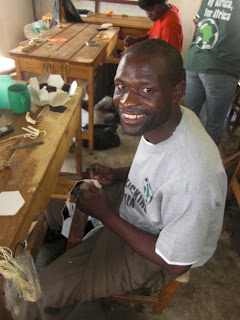
I sat with Chris, one of the stitchers (pictured below). He told me about his average day at the stitching centre, located at ZamLeather, Zambia’s biggest producer of leather.
All of the stitchers seemed to enjoy their job and enjoyed a good standard of living, all of which is of course relevant to the country in which they live.
It was a pleasant environment to be around and seemed nice enough to be working in. There was a good atmosphere and additional activities were encouraged by the management. The workers were very enthusiastic about their work football team, playing every Saturday morning in a league.
Chad treated me to lunch – nshima, chicken, tomatoes and cabbage. I can quite comfortably say I’ll miss Zambian food so much when I return back to Britain.
After lunch, we returned to our conversation about the organisation – I call it an organisation because it stretches well beyond the definition of a business – offering a decent standard of living for those that would ultimately struggle otherwise.
There are reasons to remain optismistic – since their company’s birth, they’ve created over 130 jobs for Africans. Despite their American managing director, they stay true to their roots boosting of the fact their products are: made by Africans, in Africa for Africans on their company t-shirts. Through their work, they’ve targeted over 25,000 children with the intention of educating them about the dangers of HIV/AIDS. They’ve distributed 250,000 footballs, netballs and volleyballs all together. After today, they will have distributed 250,001. You can order personalised footballs or organisations such as EduSport and Sport In Action can have a specific design for their required desires.
Friend of EduSport, a UK charity supporting the work of EduSport last week created a formal partnership with Alive and Kicking. Supporting their work and ordering ten footballs for their Go! Sisters world series to be held next year, Friend of EduSport are more than happy to give Alive and Kicking business.
Made in Africa, by Africa, for Africa – Alive and Kicking.

I came to find out about Alive and Kicking through the two Sport NGOs I’m working with out in Zambia. EduSport and Sport In Action both purchase their footballs from Alive and Kicking. Our equipment cupboard at the house is packed to the rafters with their products. Each ball proudly displays their logo, a warning of the dangers of malaria and their real signature, the writing ‘Against child labour’ around the ball’s air supply.
A massive fan of their ideals and interested to find out more, I managed to organise a meet with their Managing Director, Chad. True to most communication in the 21st century Chad and I originally conserved through SMS, therefore, I was caught offguard when we eventfully met in person. Chad is a American, and white – an important factor. I must admit, my first reaction was that of cyncialism. I was wary that perhaps everything I had heard of Alive and Kicking had been created for intentional marketing purposes. I guess that’s just a product of living in a Western society.
However, it didn’t take me long to realise I had been massively wrong. Almost immediately after we had passed our introductions, Chad offered me a cup of tea (after I told him I was English). One thing that struck me straight away about him was how passoniate he was about his job and how thoroughly he believed in it. Although he had only been in his role since September of 09, you’d think the way he spoke about the company, it was his own.
We spoke for a while, about Alive and Kicking, and also about the IDEALS project I was proud to be apart of. He was genuine and although he stated how manic his past week had been, he had made plenty of time for our meet. I was given a tour of the stitching rooms, which were spacious. I was told of the process of making a ball and shortly learnt of the skill required to be able to stitch.
Each stitcher has the aim of making 3 balls a day – which doesn’t sound a lot, but Alive and Kicking balls are of the highest standard. Even in the terrains of the compounds the IDEALS students operate, the Alive and Kicking balls are hard wearing and do not fall apart – something more famous production company’s products could be accused of.
I sat with Chris, one of the stitchers (pictured below). He told me about his average day at the stitching centre, located at ZamLeather, Zambia’s biggest producer of leather.

All of the stitchers seemed to enjoy their job and enjoyed a good standard of living, all of which is of course relevant to the country in which they live.
It was a pleasant environment to be around and seemed nice enough to be working in. There was a good atmosphere and additional activities were encouraged by the management. The workers were very enthusiastic about their work football team, playing every Saturday morning in a league.
Chad treated me to lunch – nshima, chicken, tomatoes and cabbage. I can quite comfortably say I’ll miss Zambian food so much when I return back to Britain.
After lunch, we returned to our conversation about the organisation – I call it an organisation because it stretches well beyond the definition of a business – offering a decent standard of living for those that would ultimately struggle otherwise.
There are reasons to remain optismistic – since their company’s birth, they’ve created over 130 jobs for Africans. Despite their American managing director, they stay true to their roots boosting of the fact their products are: made by Africans, in Africa for Africans on their company t-shirts. Through their work, they’ve targeted over 25,000 children with the intention of educating them about the dangers of HIV/AIDS. They’ve distributed 250,000 footballs, netballs and volleyballs all together. After today, they will have distributed 250,001. You can order personalised footballs or organisations such as EduSport and Sport In Action can have a specific design for their required desires.
Friend of EduSport, a UK charity supporting the work of EduSport last week created a formal partnership with Alive and Kicking. Supporting their work and ordering ten footballs for their Go! Sisters world series to be held next year, Friend of EduSport are more than happy to give Alive and Kicking business.
Made in Africa, by Africa, for Africa – Alive and Kicking.

Friday, July 30, 2010
You Only Get Fatter In Chipata
To any Muzungo unfamiliar with the Nyanja language, to say to someone that they are getting or look fat, or ‘dumbo’, would seem fairly rude. However, in Zambia, to tell someone they look fat means that they look healthy and should (mostly) always be taken as a compliment. The staple food all over Zambia, nshima, is a national favourite and very filling, making everyone feel ‘dumbo’ afterwards. Made from just maize and boiling water, it comes out like a bland variety of mash potato – I know, it doesn’t sound appealing but it tastes fantastic, especially when typically served with cabbage and meat.
And this was the challenge for Laura and myself when I went with Laura to her placement in Chipata. After delivering PE lessons in the morning, we found ourselves with an hour to spare and at a bit of a loose end in the afternoon as the exam period meant some classes weren’t available. So we found ourselves willingly dragged into cooking and preparing a meal for all the teachers, which of course included nshima. Zambians are very keen to get you involved in anything, but are also very keen to make sure you do things properly; no sooner had Laura and I picked up a spoon and started stirring, we had them taken off us and shown how to stir properly.
The moral of this story – never argue with a middle aged Zambian woman in her kitchen.
Despite causing a stir in the kitchen, the nshima went down very well with the teachers, though, not as well as the game of softball we played with class 6B in the morning. As you can imagine, the schools we go to don’t have much if any PE equipment, so any equipment that the student coaches plan for in their sessions, must be taken from what they brought with them to Zambia. Laura brought a softball bat and tennis ball to Chipata and it was an absolute success. They’ve never played softball before, and even the teachers were intrigued, saying they had watched baseball on the telly but had never played.
The class picked it up pretty quickly. Laura’s session focus was not about winning, losing or getting people out but instead on something much more important: teamwork. It’s life skills like this that the student coaches are trying to get across in their sessions; yes, they want the kids to have fun as that is and always should be the point of any sporting activity, but they also want these kids to learn such life skills to use off the pitch.
Discipline and communication also featured heavily in Laura’s sessions, especially with the younger children. At this age (6-7 years old), their English is not as good as the older children, so doing a PE session and without a Peer Leader to help translate as was the case on this day, is challenging. However, Laura coped impressively well, her PE teacher background coming to the fore as she easily made it clear at all times for them all to ‘watch!’ (pointing to eyes) and ‘listen!’ (cupping ears) to her as she went through each activity. She wasn’t taking any nonsense either; if there was any sign of pushing or squabbles amongst the kids, she stopped the activity immediately, sending the offenders to the back of the line and threatening to leave them out all together for re-offending. Perhaps it was the Scottish accent that scared them stiff into obeying, but either way they soon realised they had to play nice to play at all.
You can see from their reaction to Laura that the kids have really taken to her, and she has really loved her time at Chipata Open Community School so far. ‘Everyone is so relaxed here, I love it’ she said. ‘You just have to go with it. If your taking a class for PE and another class wants to join in, that’s fine. You regularly get a class of 20 grow to 100 very quickly’.
Like Chawama, Chipata is a long way from Group 2’s base, taking about an hour and a half by bus. Being on her own without a placement partner as well, it is arguably the most difficult placement to be at. But calm as ever, Laura takes it in her stride, casually claiming ‘I don’t mind. There’s usually Chiko (the peer leader) around to help and there is usually always someone free in the group to come with me everyday.’ On this particular day it was me, and I can definitely say I will be visiting again.
And this was the challenge for Laura and myself when I went with Laura to her placement in Chipata. After delivering PE lessons in the morning, we found ourselves with an hour to spare and at a bit of a loose end in the afternoon as the exam period meant some classes weren’t available. So we found ourselves willingly dragged into cooking and preparing a meal for all the teachers, which of course included nshima. Zambians are very keen to get you involved in anything, but are also very keen to make sure you do things properly; no sooner had Laura and I picked up a spoon and started stirring, we had them taken off us and shown how to stir properly.
The moral of this story – never argue with a middle aged Zambian woman in her kitchen.
Despite causing a stir in the kitchen, the nshima went down very well with the teachers, though, not as well as the game of softball we played with class 6B in the morning. As you can imagine, the schools we go to don’t have much if any PE equipment, so any equipment that the student coaches plan for in their sessions, must be taken from what they brought with them to Zambia. Laura brought a softball bat and tennis ball to Chipata and it was an absolute success. They’ve never played softball before, and even the teachers were intrigued, saying they had watched baseball on the telly but had never played.
The class picked it up pretty quickly. Laura’s session focus was not about winning, losing or getting people out but instead on something much more important: teamwork. It’s life skills like this that the student coaches are trying to get across in their sessions; yes, they want the kids to have fun as that is and always should be the point of any sporting activity, but they also want these kids to learn such life skills to use off the pitch.
Discipline and communication also featured heavily in Laura’s sessions, especially with the younger children. At this age (6-7 years old), their English is not as good as the older children, so doing a PE session and without a Peer Leader to help translate as was the case on this day, is challenging. However, Laura coped impressively well, her PE teacher background coming to the fore as she easily made it clear at all times for them all to ‘watch!’ (pointing to eyes) and ‘listen!’ (cupping ears) to her as she went through each activity. She wasn’t taking any nonsense either; if there was any sign of pushing or squabbles amongst the kids, she stopped the activity immediately, sending the offenders to the back of the line and threatening to leave them out all together for re-offending. Perhaps it was the Scottish accent that scared them stiff into obeying, but either way they soon realised they had to play nice to play at all.
You can see from their reaction to Laura that the kids have really taken to her, and she has really loved her time at Chipata Open Community School so far. ‘Everyone is so relaxed here, I love it’ she said. ‘You just have to go with it. If your taking a class for PE and another class wants to join in, that’s fine. You regularly get a class of 20 grow to 100 very quickly’.
Like Chawama, Chipata is a long way from Group 2’s base, taking about an hour and a half by bus. Being on her own without a placement partner as well, it is arguably the most difficult placement to be at. But calm as ever, Laura takes it in her stride, casually claiming ‘I don’t mind. There’s usually Chiko (the peer leader) around to help and there is usually always someone free in the group to come with me everyday.’ On this particular day it was me, and I can definitely say I will be visiting again.
Thursday, July 29, 2010
Friend Of EduSport's Chawama SEE Project
The Zambian government currently spends 136 times more money on every University student than on every Primary School student, making it hard for Primary schools to get anywhere near to the level of education they’d want to be able to offer students.
Chawama SEE (Sport Empowerment and Education) School uses the power of sport to educate, empower and inspire young individuals who attend the school. They are currently renting the land on which they teach at the cost of K1,000,000 per month, which equates to roughly around £150, which value is considerably more in Zambia than it is in Britain.

Should Chawama SEE own their own land, they’d be able to spend that K1,000,000 a month on developing and increasing its reach to young underprivileged children in the area.
Chawama is an area in which Zambian Non-Government Organization EduSport currently deploy peer leaders to utilise sport to tackle problems in society such as drug and alcohol abuse and teach of the dangers of unprotected sex.

The HIV/AIDS virus is something that should Chawama SEE be able to afford, wants to educate its pupils about comprehensively, as only 46% of young people in Zambia have knowledge of. There are currently around 710,000AIDS orphans in Zambia in an overall population of 12,000,000, something which can be prevented.
Purchasing the land would firstly allow a more sustainable future for the school and secondly allow for a more stable education environment for the children of Chawama. Should they be able to do this, they’d be able to promote a quality of education vacant in many Zambian schools. Land would also allow for the development of sport as a priority within the school and the development of CSEE into a peer leader academy of excellence.

Friend of EduSport are trying to help Chawama SEE purchase land so they can help the school educate young people of the dangers ofHIV/AIDS. Operating in a particularly underprivileged area of Lusaka, should Chawama receive the financial backing required to own their required land, they’d reduce entry school fees to encourage family’s to send their children to school when they previously may have not been able to afford education.
The school’s entry fees would then be around 50% less than in the majority of other schools in Lusaka,with that original fee also covering exam fees.
Chawama SEE (Sport Empowerment and Education) School uses the power of sport to educate, empower and inspire young individuals who attend the school. They are currently renting the land on which they teach at the cost of K1,000,000 per month, which equates to roughly around £150, which value is considerably more in Zambia than it is in Britain.

Should Chawama SEE own their own land, they’d be able to spend that K1,000,000 a month on developing and increasing its reach to young underprivileged children in the area.
Chawama is an area in which Zambian Non-Government Organization EduSport currently deploy peer leaders to utilise sport to tackle problems in society such as drug and alcohol abuse and teach of the dangers of unprotected sex.

The HIV/AIDS virus is something that should Chawama SEE be able to afford, wants to educate its pupils about comprehensively, as only 46% of young people in Zambia have knowledge of. There are currently around 710,000AIDS orphans in Zambia in an overall population of 12,000,000, something which can be prevented.
Purchasing the land would firstly allow a more sustainable future for the school and secondly allow for a more stable education environment for the children of Chawama. Should they be able to do this, they’d be able to promote a quality of education vacant in many Zambian schools. Land would also allow for the development of sport as a priority within the school and the development of CSEE into a peer leader academy of excellence.

Friend of EduSport are trying to help Chawama SEE purchase land so they can help the school educate young people of the dangers ofHIV/AIDS. Operating in a particularly underprivileged area of Lusaka, should Chawama receive the financial backing required to own their required land, they’d reduce entry school fees to encourage family’s to send their children to school when they previously may have not been able to afford education.
The school’s entry fees would then be around 50% less than in the majority of other schools in Lusaka,with that original fee also covering exam fees.
Thursday, July 8, 2010
Kicking Aids Out
Over 2,000,000 African’s die from the HIV/AIDS virus every year and 7.3% of the population of the continent between 15 and 49 are infected by it.
This startling statistics seriously hampers Zambia’s progression as a nation, currently the world’s 8th poorest country. Only 46% of the young population of Zambia have a comprehensive knowledge of HIV/AIDS and there are currently around 710,000 AIDS orphans in Zambia.
Kicking Aids Out is an African organisation which aims to raise the awareness of the dangers of unprotected sex. Both Lusaka based Sport NGOs EduSport and Sport In Action are part of the network which help deliver the message of Kicking Aids Out.
From the 3rd to the 6th of July, EduSport was helping its peer leaders gain their level one qualification to educate young people about the virus. EduSport staff Paul Zulu and Klevin Chasauka held the workshop at Bauleni to over 20 peer leaders who will use the knowledge gained to good effect.
Klevin Chasauka said “Most the people are cornerstones of their communities and they will take this knowledge gained to a higher level for the benefit of many”.
The peer leaders were taught about the prevention of HIV/AIDS through the practice of abstinence and the use of protection along with the best way to deliver the knowledge they had gained over the four days.
One of the attending peer leaders, Christian, said “Since I came here to attend Kicking Aids Out Level One, I feel I will be able to coach the knowledge I have gained at the workshops”.
The objective of Kicking Aids Out is that knowledge will be passed down through communities to young people who will in turn teach and educate other young people about the dangers of unprotected sex and the transference of the HIV virus.
This startling statistics seriously hampers Zambia’s progression as a nation, currently the world’s 8th poorest country. Only 46% of the young population of Zambia have a comprehensive knowledge of HIV/AIDS and there are currently around 710,000 AIDS orphans in Zambia.
Kicking Aids Out is an African organisation which aims to raise the awareness of the dangers of unprotected sex. Both Lusaka based Sport NGOs EduSport and Sport In Action are part of the network which help deliver the message of Kicking Aids Out.
From the 3rd to the 6th of July, EduSport was helping its peer leaders gain their level one qualification to educate young people about the virus. EduSport staff Paul Zulu and Klevin Chasauka held the workshop at Bauleni to over 20 peer leaders who will use the knowledge gained to good effect.
Klevin Chasauka said “Most the people are cornerstones of their communities and they will take this knowledge gained to a higher level for the benefit of many”.
The peer leaders were taught about the prevention of HIV/AIDS through the practice of abstinence and the use of protection along with the best way to deliver the knowledge they had gained over the four days.
One of the attending peer leaders, Christian, said “Since I came here to attend Kicking Aids Out Level One, I feel I will be able to coach the knowledge I have gained at the workshops”.
The objective of Kicking Aids Out is that knowledge will be passed down through communities to young people who will in turn teach and educate other young people about the dangers of unprotected sex and the transference of the HIV virus.
The Streets Of Lusaka
We walk through Kamwala shopping complex. After a month in Zambia the narrow streets with dust and dirt have become second nature to me. The colours that are now familiar are all different from the ones I see back home; everything from the warm orangey brown of the streets to the various pastels of the shops’ front doors. The shops that are small enough to be labelled as shacks. I walk along, say hello, and try to look like I belong. The only thing that gives me away is the colour of my skin.
We reach the end of Kamwala; the roads become bigger and more heavily trafficked. When crossing through a small tunnel under the motorway, my friend says “this is where I used to sit when I was sniffing petrol”. And we all agree that it’s a good place because it keeps you sheltered from the wind. The lady who is crouching at the end of the tunnel when we walk back silently concurs.
The road opens up into a field: an array of mud, dry grass and garbage. We walk up to a group of people who have gathered under a tree. A crippled man and four young boys – all of them living on the streets of Lusaka. The man tells us how he was injured in a car accident, and he pulls up his jeans to reveal a severely deformed limb. He couldn’t afford to go to the hospital, and now his leg is forever fixed in that unnatural angle. We give him some money to buy pain killers. And I think that if he is tricking us to get money for drugs, at least it will have the same effect.

Next to the field is a train station. An old steam engine is parked on the abandoned train tracks, and I think it looks like a museum, or like it is part of an exhibition of some sort. My friend tells me that this is where the street children sleep. He takes me onto the train and shows me the interior of the engine which is wrapped in dirty blankets and old clothing. Someone is sleeping inside. On the other side of the tracks is a sign, bidding me welcome to Lusaka railway station.

We cross the bridge over the train tracks and make our way into town. Every place we pass is another area of the life of the street children. This is where they beg for money. This is where they steal. This is where they play. A worn down wall with fading blue paint bears an inscription that we stop to admire; an inscription that seems like a voice from the streets of Lusaka. “JESUS HELP ME”

We reach the end of Kamwala; the roads become bigger and more heavily trafficked. When crossing through a small tunnel under the motorway, my friend says “this is where I used to sit when I was sniffing petrol”. And we all agree that it’s a good place because it keeps you sheltered from the wind. The lady who is crouching at the end of the tunnel when we walk back silently concurs.
The road opens up into a field: an array of mud, dry grass and garbage. We walk up to a group of people who have gathered under a tree. A crippled man and four young boys – all of them living on the streets of Lusaka. The man tells us how he was injured in a car accident, and he pulls up his jeans to reveal a severely deformed limb. He couldn’t afford to go to the hospital, and now his leg is forever fixed in that unnatural angle. We give him some money to buy pain killers. And I think that if he is tricking us to get money for drugs, at least it will have the same effect.

Next to the field is a train station. An old steam engine is parked on the abandoned train tracks, and I think it looks like a museum, or like it is part of an exhibition of some sort. My friend tells me that this is where the street children sleep. He takes me onto the train and shows me the interior of the engine which is wrapped in dirty blankets and old clothing. Someone is sleeping inside. On the other side of the tracks is a sign, bidding me welcome to Lusaka railway station.

We cross the bridge over the train tracks and make our way into town. Every place we pass is another area of the life of the street children. This is where they beg for money. This is where they steal. This is where they play. A worn down wall with fading blue paint bears an inscription that we stop to admire; an inscription that seems like a voice from the streets of Lusaka. “JESUS HELP ME”

Subscribe to:
Posts (Atom)